Watershed Transforms
Watershed transforms can be a powerful technique for separating the overlapping objects in an image. This technique uses the labels of a multi-ROI as the seed points and a landscape image whose 'catchment basins' correspond to the objects you want to identify. In the example below, a watershed transform was applied to segment the grains in a sandpack dataset.
Original image (left) and the result of applying a watershed transform to segment the grains (right)

 Watershed Transform Video Tutorial
This video introduces users to the Watershed Transform function in Dragonfly.
Watershed Transform video tutorial (39:36)
You can also view this video and others on our YouTube channel (www.youtube.com/channel/UCuFl2zHcyStR2RJpMXbi6ow).
Applying Watershed Transforms
You should first complete all of the required pre-processing steps before you attempt to apply a watershed transform to your data. This can include creating a landscape image whose 'catchment basins' are the objects that you want to identify, creating a multi-ROI with the required seed points, and creating a mask to define the area of application for the watershed transform. Refer to the topics in Pre-Processing Steps for information about these steps.
- Right-click the multi-ROI that will provide the seed points and then choose Watershed Transform in the pop-up menu.
Note Refer to the topic Seeds for information about creating multi-ROIs that will provide the seed points.
- Choose the dataset that will provide the local topography for the watershed transform in the Choose a landscape dialog, as shown below.
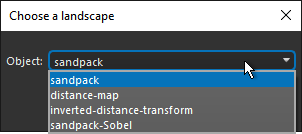
Note Refer to the topic Landscape Images for information about creating landscape images.
-
Click OK.
The Choose an ROI as Mask dialog appears.
-
Choose a mask in the Object drop-down menu, optional.
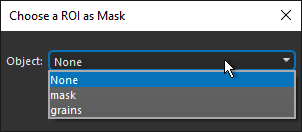
Note Masks let you define the area of application for the watershed transform. Refer to the topic Creating Masks for information about creating masks.
- Click OK.
The watershed is evaluated with the seeds and the selected landscape image. Wait for the expanded objects to be computed and then overwritten into the initial multi-ROI.